Table Of Content
I personally prefer the first approach (header), because it doesn't require clients to learn a "rule" that is specific to our application for transforming URLs. The argument for a header would be stronger if someone would standardize Accept-Version so it could be referenced by all applications. Links are always written using URLs of resources that do not contain version numbers. If clients want to request a specific version of a resource, there are two choices. The first is to allow clients to provide an Accept-Version header in their requests.

Designing and managing APIs: Best practices & common pitfalls
I make the assumption that it is the job of the client code to know what actions it wants to perform and how to perform them [using standard HTTP methods, of course]. Even the modern browser works this way, since operations are now usually coded in Javascript executed in the client rather than using old-school HTML forms prepared on the server. You can test things out by adding a workout with the same name twice or not providing a required property inside your request body. You should receive the corresponding HTTP error codes along with the error message. To do that, we need a database and a collection of methods that actually handle the database interaction. Our database will be a simple JSON file that is pre-filled with some workouts already.
Whenever you're ready
Additionally, regular testing and debugging can help maintain the integrity of your API routes. In this code snippet, any request to /api/user/123 will be handled by this route, with 123 captured as the id. The req.query.id will contain the ID passed in the URL, allowing you to perform operations such as retrieving user information based on this ID.
Use standard JSON libraries
Nushell is a modern, performant, extensible shell built with Rust. Explore its pros, cons, and how to install and get started with it. It is recommended to use fewer nesting levels to prevent overcomplicating your application; you can use filtering to reduce the number of nesting levels.
Best Practices for API Quality and Security - InfoQ.com
Best Practices for API Quality and Security.
Posted: Wed, 21 Dec 2022 08:00:00 GMT [source]
But the overall performance of our API is another key factor we should work on. Imagine the frontend also needs an endpoint to get information about which member exactly holds the current record and wants to receive metadata about them. Now we're able to create a new route in our workout router and direct the request to our record service. We filter all the records that are related to the workout id out of the query parameter. We've got a resource called "workouts" on the one side and another called "records" on the other side. Now, the frontend needs an endpoint that responds with all records for a specific workout in order to display it in the UI.
Implement Pagination
So you have to add another checking logic to that route and validate if the user has the privilege to access this resource. In Express, for example, you can implement it as a middleware like we did with our cache for specific routes and check first if the request is authenticated before it accesses a resource. Inside Postman or another HTTP client of your choice, define a new request that gets all workouts. I've done it inside the browser until now, but I'd like to visualize the response times better for you. That's the reason why I'm requesting the resource via Postman right now. That's the reason why filtering and pagination are important.
Overusing Verbs and CRUD Operations

A web API exposes server data to client users and accepts requests back from them. Most consumer web traffic is data served to clients by request. In the opposite direction, clients supply login data, make purchases, fill out government forms, and the like. Let's say external users are making multiple queries on an API service, and the API will query other services to get users' desired data. An API communicates with two applications using requests and responses. We should never use verbs like DELETE, PUT, or GET in our API endpoints as they are similar to the standard HTTP request methods.
In essence, filter implements search, while sort allows the query to change the order preference. These are two of the most common features in e-commerce, or in any database. We just add the version number to the start of the endpoint URL path to version them. This way, we can gradually phase out old endpoints instead of forcing everyone to move to the new API at the same time.
There are many tools on the market to help generate quality, up-to-date documentation from your API descriptions. When you involve others in API design, you build something better. The API spec becomes an artifact upon which they can comment.
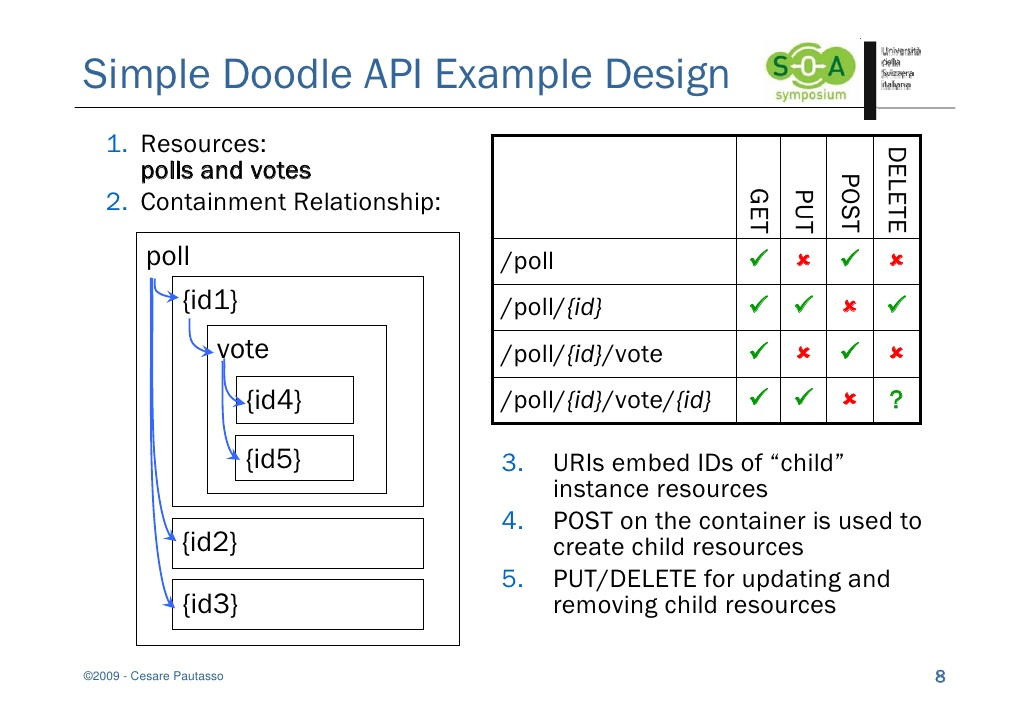
The important thing is that every URL should identify some resource. Does this mean that I am violating the HATEOAS constraint of REST? Web developer and technical writer focusing on frontend technologies. GET, POST, PUT, PATCH, and DELETE are the commonest HTTP verbs. There are also others such as COPY, PURGE, LINK, UNLINK, and so on. This is because, with XML for example, it's often a bit of a hassle to decode and encode data – so XML isn’t widely supported by frameworks anymore.
The v1 endpoint can stay active for people who don’t want to change, while the v2, with its shiny new features, can serve those who are ready to upgrade. We should version them so that we won't break third party apps that use our APIs. If we choose to group users into a few roles, then the roles should have the permissions that cover all they need and no more.
A GitHub repository or Stoplight’s Visual OpenAPI Designer can help keep everyone on the same page. You’ll want to add other types of documentation, too, such as tutorials. Look for a tool that allows you to have customized documentation alongside your generated docs. You also may want to match your site’s style and navigation.
You can use CloudEndpoints and gRPC without following the guide. As internet traffic has increased, more and more data is being fetched every day. A good API is a backbone for any system to keep things running smoothly. If we follow the above practices while designing our APIs, the result will be highly functional and performant applications. Repeatedly requesting and responding to the same data is resource-consuming and a sign of flawed design. To fix this problem, store data fetched from the API on the server, and serve from there.
The web is made up of two parts the frontend and the backend. The front-end is also known as the client side which involves what the user sees and interacts with when they visit a website or a web application. Interested in getting started with API design for REST APIs? Notice the data types and an example described in each response item an end user can expect from a successful GET call. The successful response an end user would receive in JSON would look as follows.


No comments:
Post a Comment